
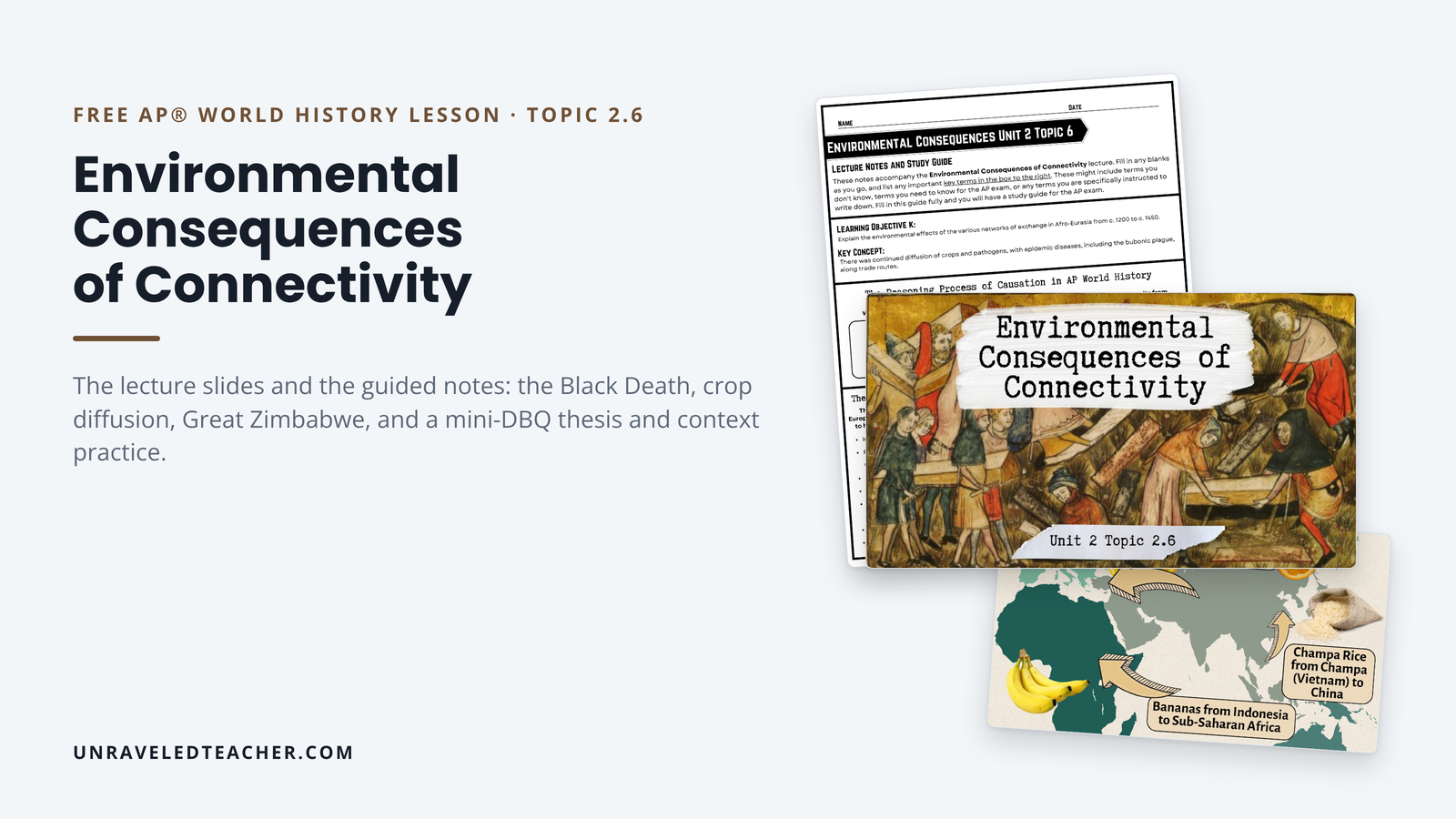
Topic 2.6 Environmental Consequences of Connectivity: a Free AP World Lesson
Want a free AP® World History writing lesson in your inbox? Click here
Topic 2.6 is one of the shortest topics in the CED: three crops, one pandemic, and a key concept that fits on a sticky note. It is easy to rush through in twenty minutes, and hard to make worth a whole class period.
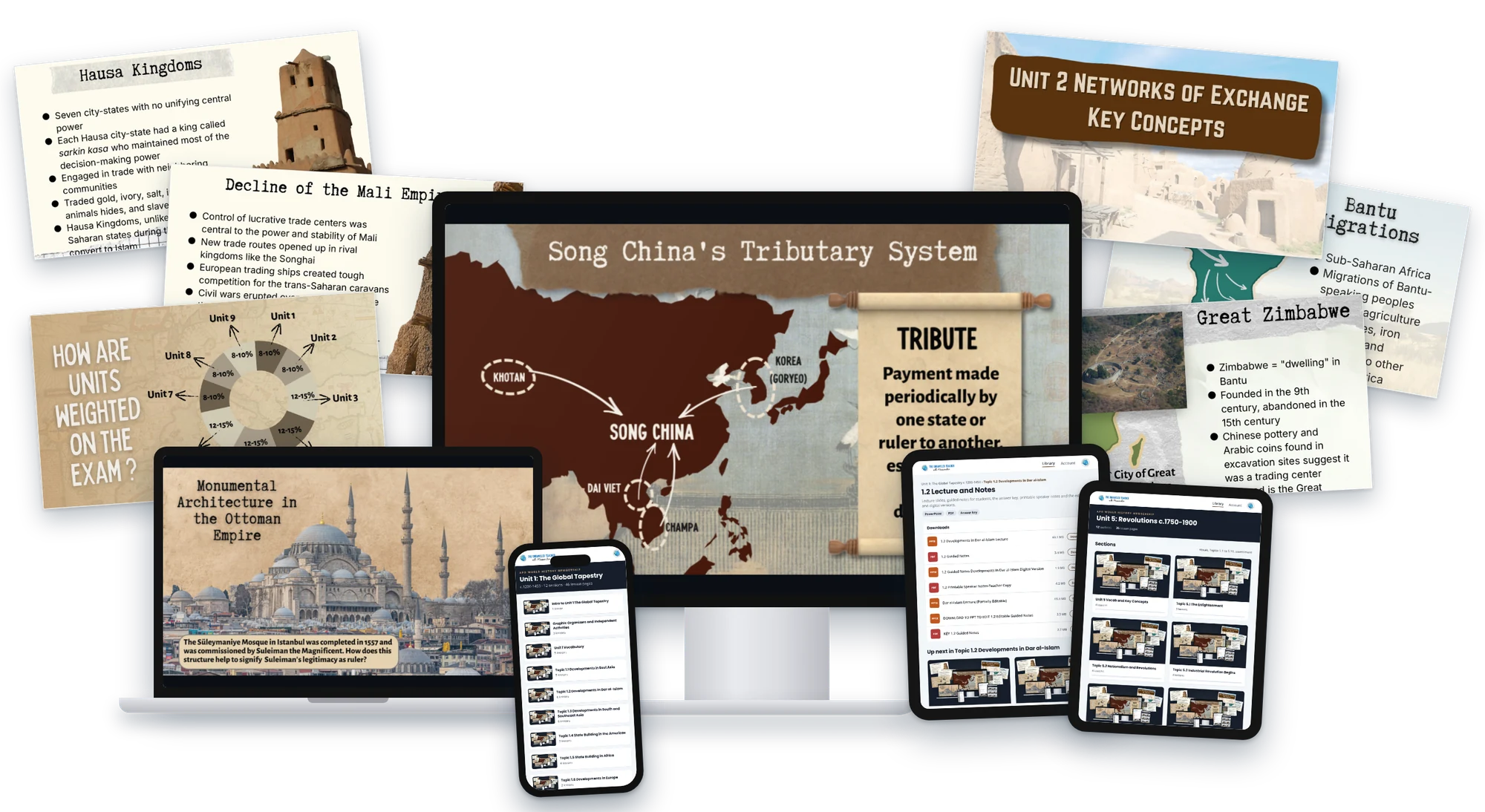
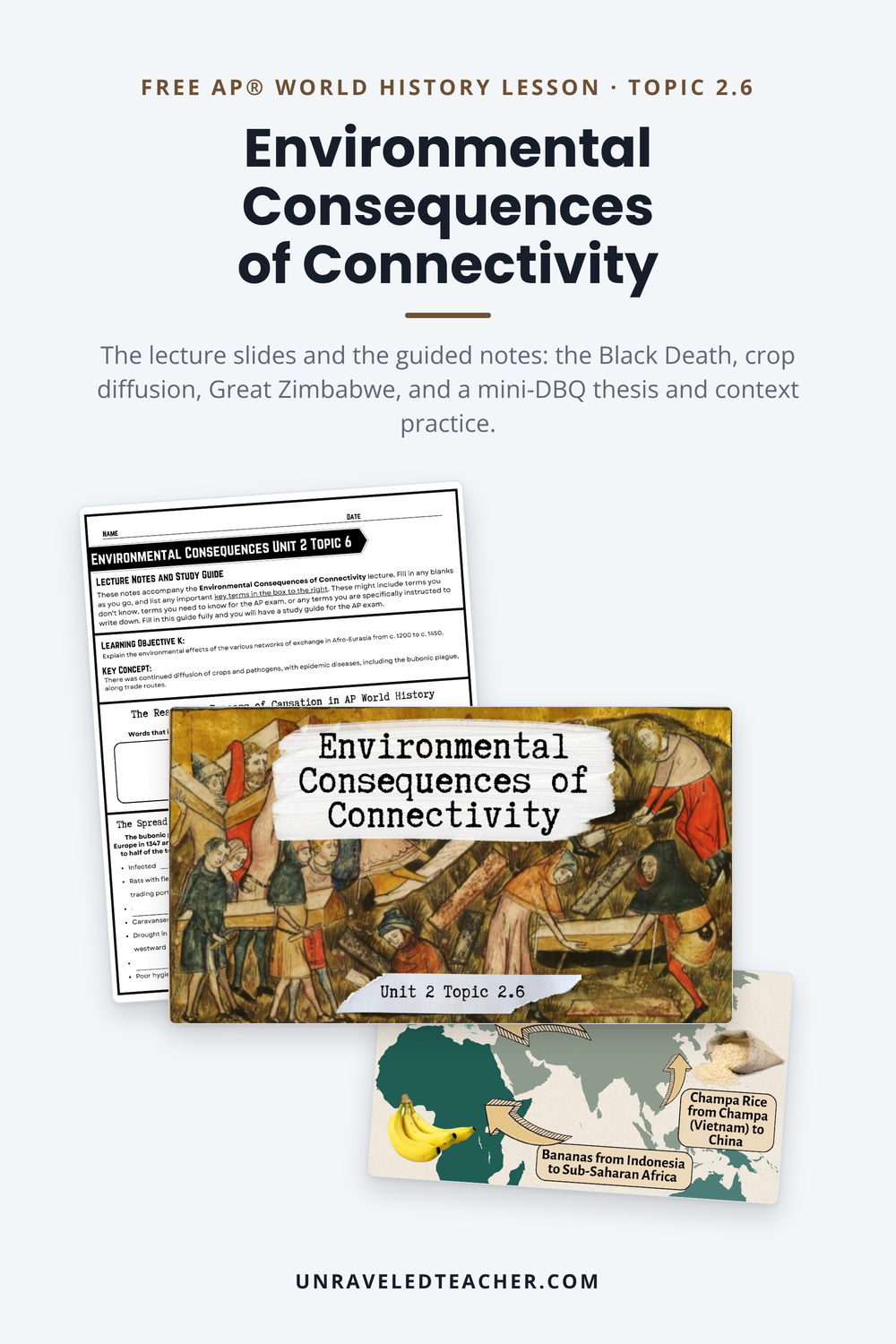
This is the lesson I built for my own AP World classes, and it is free: the 18-slide lecture and the 5-page guided notes. It covers the content, the Black Death, Champa rice, bananas, citrus and Great Zimbabwe, and it uses the plague to practice the reasoning process of causation and the two parts of a DBQ introduction, a thesis and a context statement. Open the files below and teach it tomorrow.
What students do
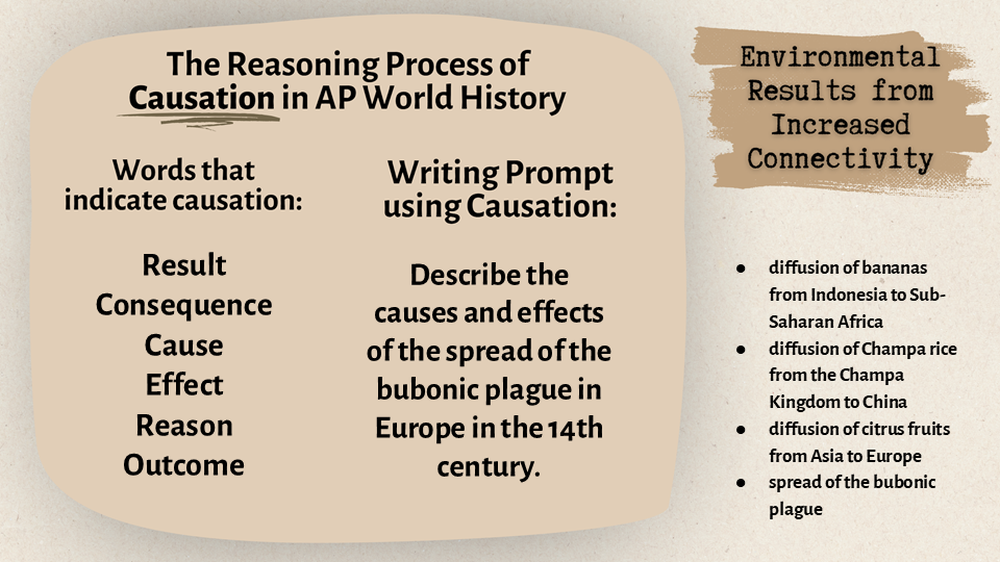
The lecture opens with the reasoning process of causation, because that is what the exam will ask of this topic. Students list the words that signal causation (result, consequence, cause, effect, reason, outcome), then meet the four events the CED names for 2.6: bananas from Indonesia to Sub-Saharan Africa, Champa rice from the Champa Kingdom to China, citrus fruits from Asia to Europe, and the spread of the bubonic plague.
One prompt runs through the whole lecture: describe the causes and effects of the spread of the bubonic plague in Europe in the 14th century. Students fill in the guided notes as they go and keep a running list of key terms in the margin, so the notes double as a study guide for the exam.
How the plague spread
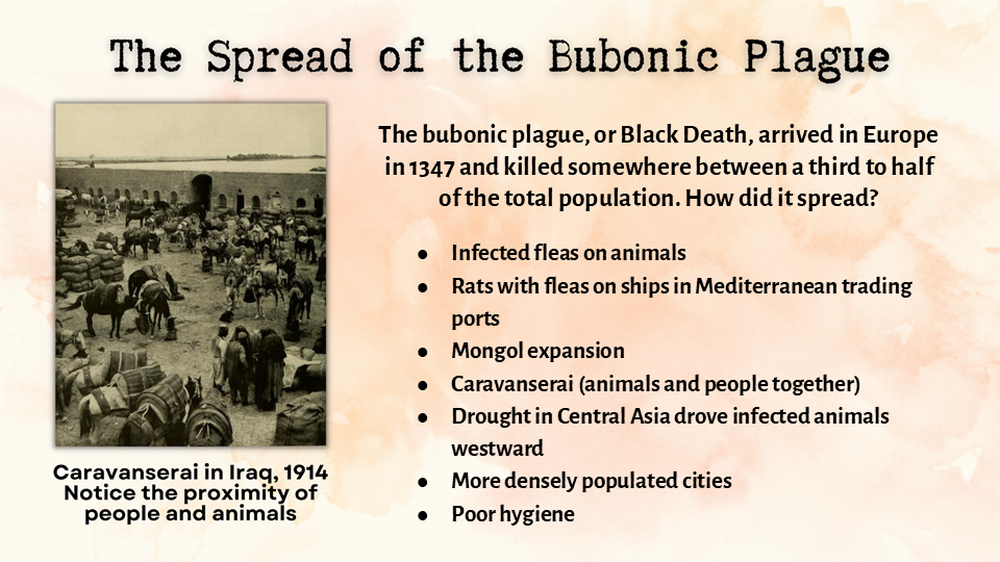
The Black Death arrived in Europe in 1347 and killed somewhere between a third and half of the population. Students fill in seven contributing factors: infected fleas on animals, rats with fleas on ships in Mediterranean trading ports, Mongol expansion, caravanserai (animals and people together), drought in Central Asia that drove infected animals westward, more densely populated cities, and poor hygiene. The thread through all of them is connectivity: the same land and sea routes that moved goods moved the disease.
Then the story of Kaffa. The Golden Horde besieged the Genoese port over control of trade in the Black Sea and the Mediterranean, the plague struck the Mongol camp in 1347, the Mongols launched infected bodies over the walls with catapults, and the ships that fled Kaffa probably carried the plague deeper into Europe. A short slide on Europe before 1347 (feudalism and serfdom, an agrarian economy, conflicts between Christians and non-Christians) gives students the context they will need later in the lesson.
Five sources on the Black Death
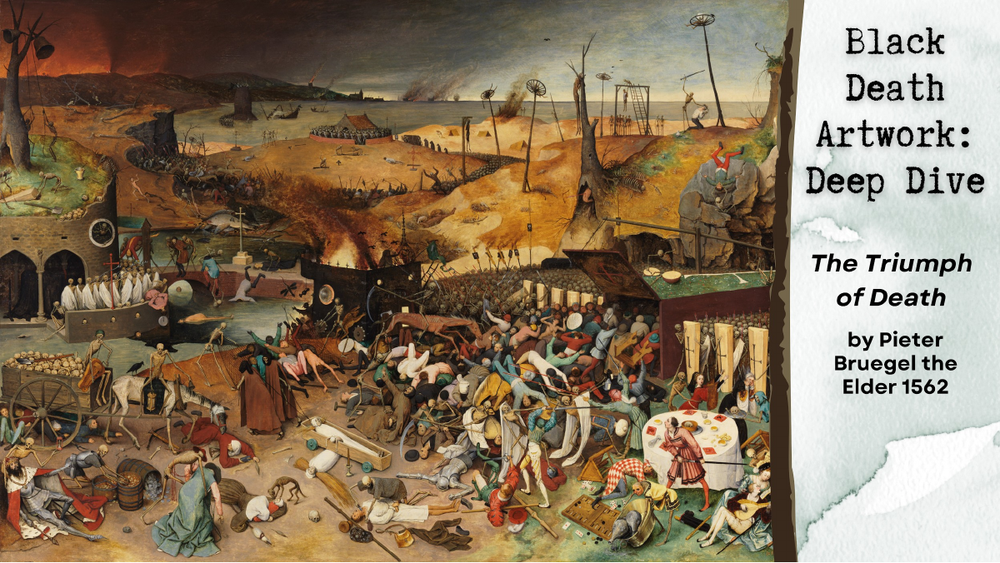
The middle of the lecture is five documents, each with questions to discuss: Bruegel's The Triumph of Death (the king in the corner, the skeletons ringing bells, the landscape, the social classes you can see), a first-hand account by Emperor John VI Cantacuzenos of Constantinople, who lost his youngest son to the plague, a drawing from the 14th-century manuscript Antiquitates Flandriae and Schweitzer's painting of the Strasbourg massacre of 1349, which open the question of why Jewish communities were blamed and persecuted, and an excerpt from Haddock and Kiesling's The Black Death and Property Rights on what a sudden labor shortage did to wages, the nobility and feudalism.
The two written excerpts are printed in the guided notes with their questions, so students can mark them up as they read.
The mini-DBQ: a thesis and a context statement
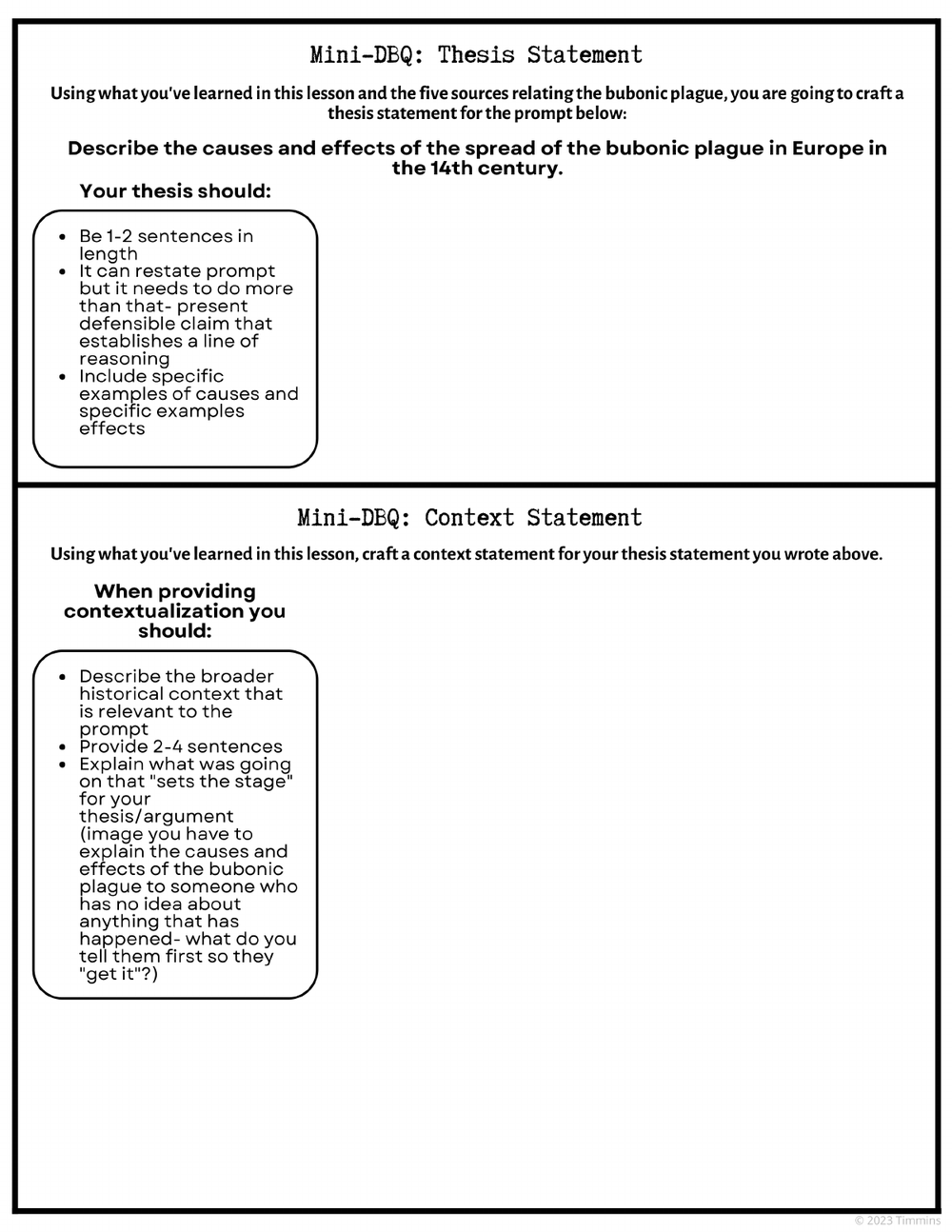
With the prompt and the sources in hand, students write a thesis in the guided notes: one or two sentences, a defensible claim that sets up a line of reasoning, with specific causes and specific effects named. The slide spells out the rules and the trap: "There were many causes and effects of the spread of the bubonic plague" restates the prompt and argues nothing. Pairs or individuals, then a few read aloud.
Then a context statement, two to four sentences that set the stage, with the slide on Europe before 1347 to lean on. The notes under the slides carry the analogy I use for context: a friend walks in halfway through a movie, and you have to catch them up before you can press play. Students put the two pieces together, and they have written a DBQ introduction without the essay behind it. The notes also suggest an optional extension into evidence and analysis with the same five documents.
Then the crops, and Great Zimbabwe
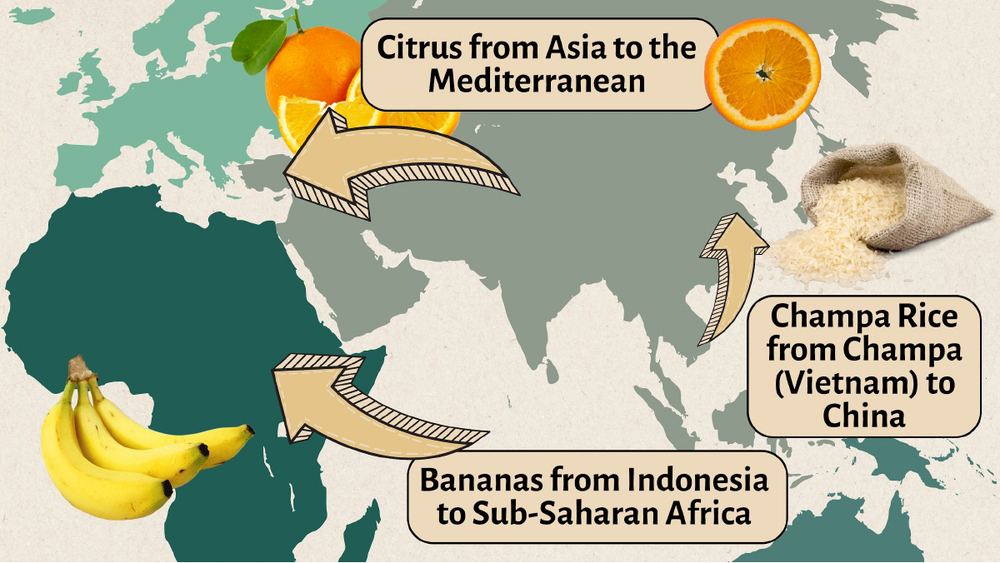
The last slides return to the content. Champa rice spread to China from Vietnam: drought-resistant, production time cut in half, more food and more people, terracing to farm land that could not be farmed before, and one more cause of urbanization in Song China (a callback to Topic 1.1). Bananas came to Sub-Saharan Africa from Southeast Asia and let people move into places that had no food supply before. Citrus came to Europe from Asia by Mediterranean trade, with the citron, lemon, lime and pomelo reaching Western Europe around the 10th and 11th centuries. Students fill in a from-and-to chart for all three.
Great Zimbabwe closes the lesson: founded in the 9th century, grown by trade, and abandoned in the 15th century when drought and overgrazing could no longer support the larger population. It is the environmental consequence running the other way, trade growing a city past what its land could carry.
Here are the free files for this lesson
Click either file. They open on the downloads page. No email needed.
- 2.6 Guided Notes for Students (PDF, 5 pages)
- 2.6 Lecture Slides (PowerPoint, 18 slides)
The Teacher Edition and answer keys are for members.
This lesson is from Unit 2: Networks of Exchange c.1200-1450
- 2.1 The Silk Roads
- 2.2 The Mongol Empire
- 2.3 Exchange in the Indian Ocean
- 2.4 Trans-Saharan Trade Routes
- 2.5 Cultural Consequences of Connectivity
- 2.6 Environmental Consequences of Connectivity (this lesson)
- 2.7 Comparisons of Economic Exchange
See everything in the membership
Want every AP® World History lesson right now?
The membership has every unit, every file, and updates whenever the College Board changes the CED. Open the topic you need tomorrow, print it, teach it.
Get a free AP® World History writing lesson
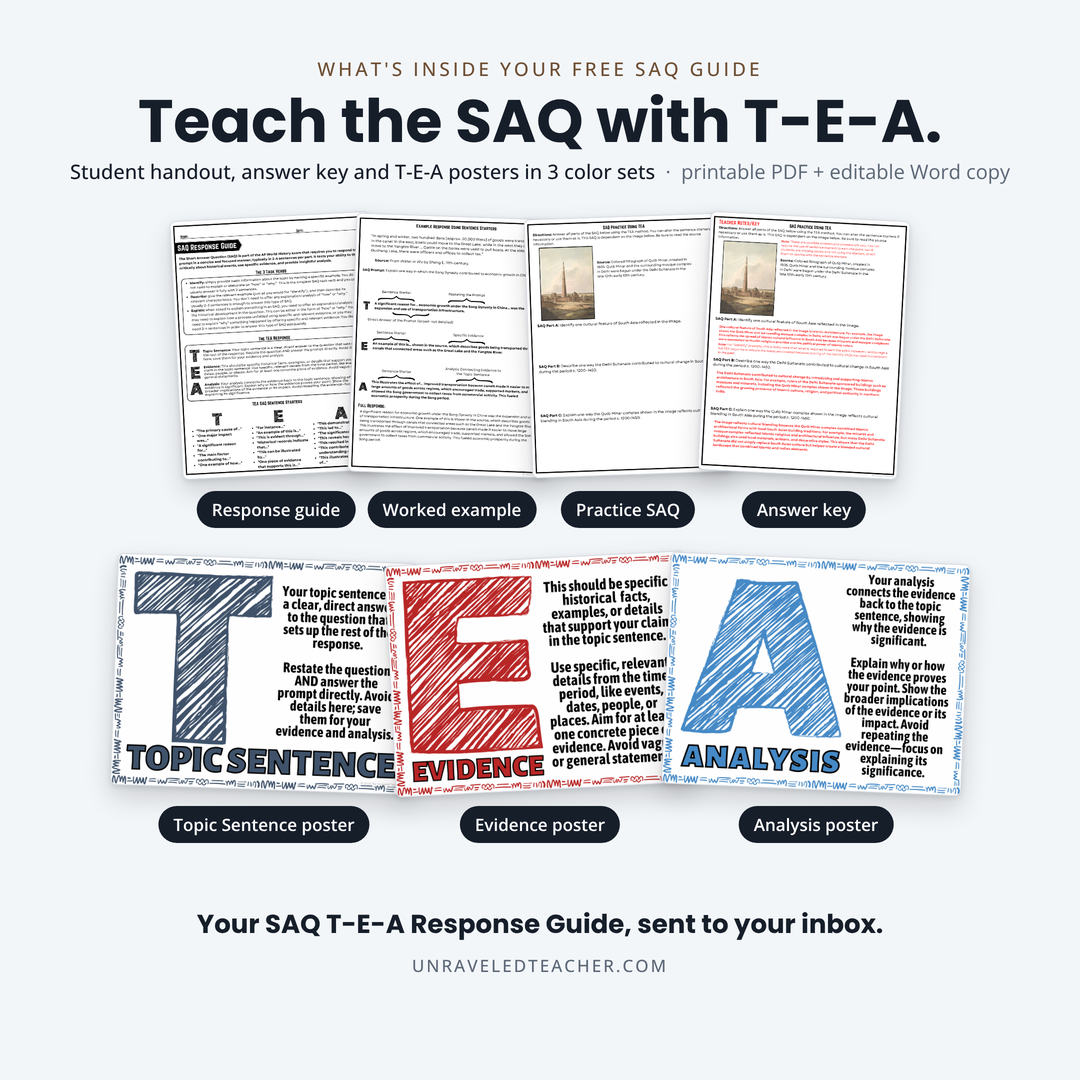
The SAQ T-E-A Response Guide, sent to your inbox: the guide, its answer key, an editable copy and the T-E-A posters. From the same membership this lesson came from.
Pin this for later
Want every AP® World History lesson, ready to teach?
The membership has every unit, every file, and updates whenever the College Board changes the CED. Open the topic you need tomorrow, print it, teach it.
Get a free AP® World History writing lesson
The SAQ T-E-A Response Guide, sent to your inbox: the guide, its answer key, an editable copy and the T-E-A posters. No credit card, nothing to cancel.
I'm a teacher too. Your email is safe with me, and you can unsubscribe any time.